

Core
Treatments
There are many treatments and therapies that can help manage symptoms of Duchenne, including steroids and physical therapy.
People with Duchenne muscular dystrophy (DMD) have little to no dystrophin, which leads to progressive muscle loss and decline. Learn about treatment options that help raise dystrophin levels and others that help manage the symptoms of Duchenne.
Meet Brantley—he is living with Duchenne and he is a paid ambassador.

For our muscles to function properly, they need a vital protein called dystrophin. People with Duchenne struggle to produce usable dystrophin due to a genetic mutation in the dystrophin gene, causing them to lose healthy muscle tissue over time. Learn more about treatment options that can help increase dystrophin levels and others that are commonly used to manage the symptoms of Duchenne.
There are many treatments and therapies that can help manage symptoms of Duchenne, including steroids and physical therapy.
Exon-skipping therapy is a pathway to increasing dystrophin because it skips a section of the dystrophin gene, helping a person with Duchenne make usable dystrophin within their body.
Gene therapy may help produce a shortened dystrophin by introducing new micro-dystrophin into the body.
Some treatments help slow the progression of Duchenne, and others help manage its impacts. The medicines and therapies below are referred to as foundational treatments because most people will use them for at least a portion of their Duchenne journey.
The muscle damage that occurs in people with Duchenne can also cause persistent inflammation, which can lead to further muscle damage and other complications. Adding an anti-inflammatory medicine to your Duchenne treatment plan may help slow muscle loss by calming inflammation.
Physical therapy is commonly used to help people with Duchenne maintain mobility and flexibility. The goal of physical therapy is to preserve the range of motion alongside strength and function. Daily stretching and swimming are also low-impact options that can be used to prevent tightening of muscles and promote joint mobility.
Many other treatment types can also help manage the symptoms of Duchenne, including osteoporosis treatment to address bone weakness, assistive mobility devices, treatments to help with breathing, and medications that address heart failure.
In order to function properly, our muscles need a vital protein called dystrophin, which helps strengthen and protect muscles. People living with Duchenne have little to no usable dystrophin, which causes them to gradually lose healthy muscle tissue. Over time, this leads to muscle weakness, balance issues, and serious health problems.
The DMD gene makes our body’s dystrophin protein. It has 79 sections called exons that each make one piece of the dystrophin protein. In most cases, people with Duchenne are missing one or more exons from their DMD gene. Exon-skipping therapy is one way to increase dystrophin in people with Duchenne. By “skipping” a section of the dystrophin, it helps the body make useable dystrophin.
Exon-skipping therapies work for specific missing exons, or deletions, within the DMD gene. A simple genetic test can help determine your deletion, which will help you understand which exon-skipping therapy you may be eligible for.
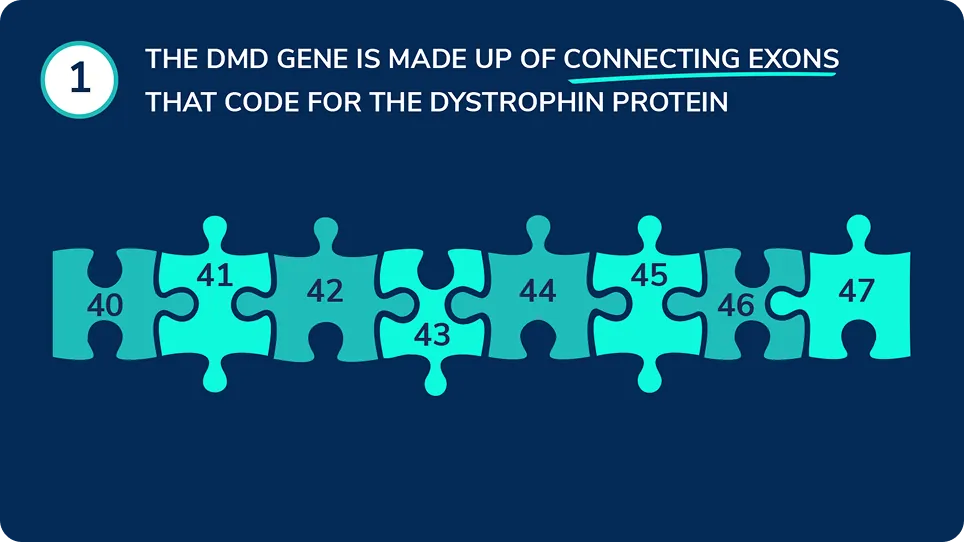
Genes have sections called exons. The DMD gene, which makes our body’s dystrophin protein, has 79 exons. Dystrophin is a key part of a group of proteins that our muscles need to function properly.
Like interlocking puzzle pieces, these exons connect together in a very precise way to code a complete protein.
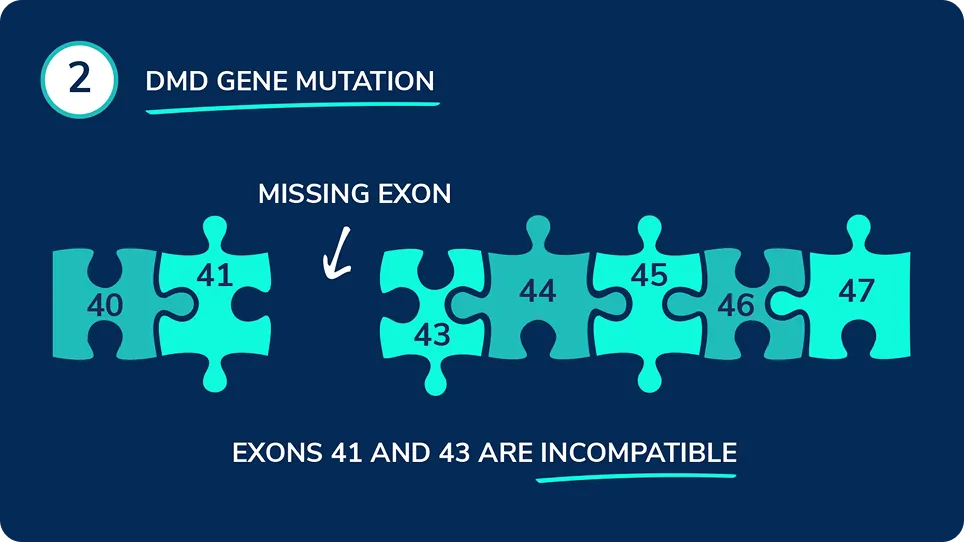
People with Duchenne have a mutation in one or more exons of their DMD gene. When exons don’t properly connect, their DMD gene makes an unusable form of dystrophin that cannot properly support their muscles.
This mutation is like a missing puzzle piece (seen here as missing exon 42). Without exon 42, exons 41 and 43 cannot connect—their shapes don’t fit. Exon-skipping therapy for DMD “skips over” exons so that compatible exons (exons 41 and 44) can connect.
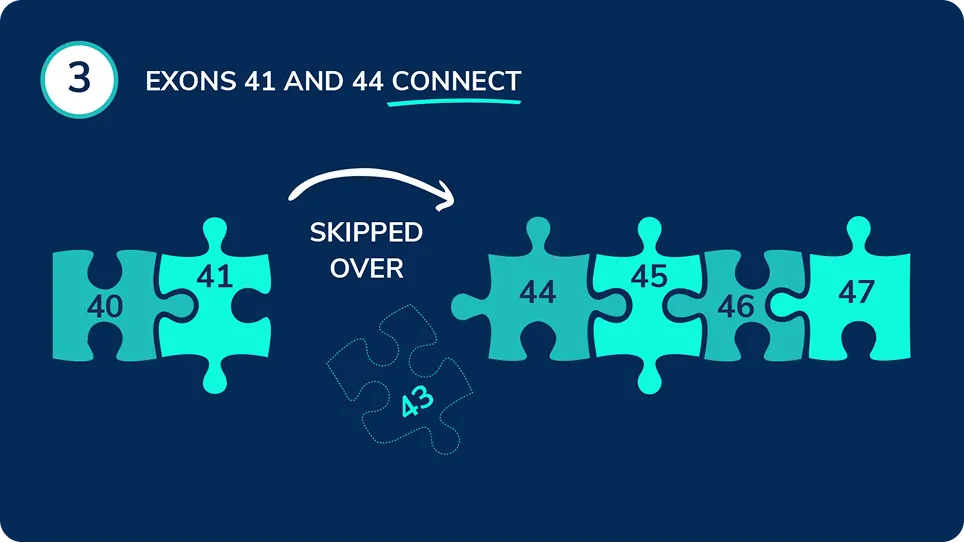
With exon 43 skipped, the remaining puzzle pieces can now connect together precisely to code a shortened but usable dystrophin protein.
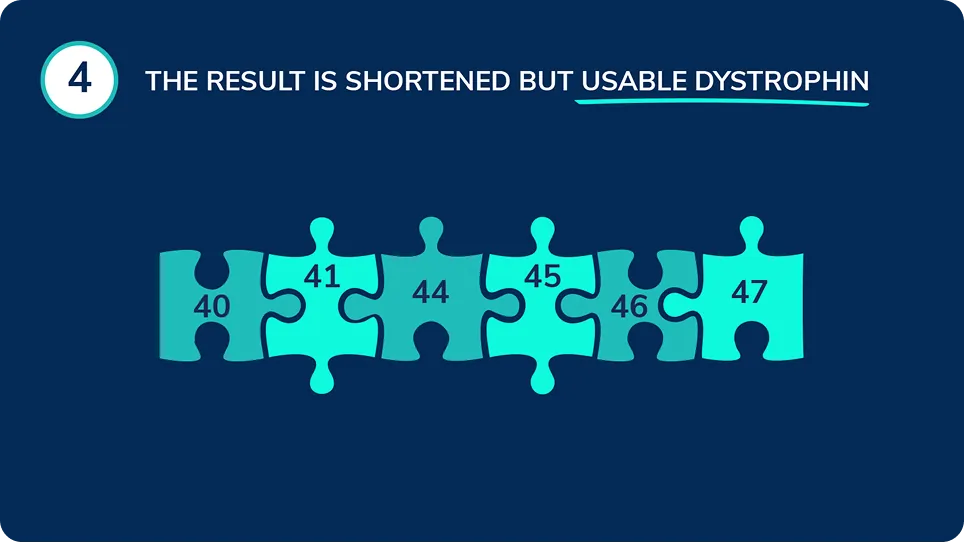
*Hypothetical example.


Since a person with Duchenne has low levels of dystrophin—or none at all—increasing dystrophin may slow the progression of the disease. Even a small increase can make a difference. This has been shown in clinical studies.
Ideally, increasing dystrophin in a person with Duchenne should happen as soon as possible, since the more time passes, the more muscle is lost. Identifying the specific genetic mutation in Duchenne is an important step, as it can help determine options for increasing dystrophin.


Gene therapy may help produce a shortened dystrophin in people with Duchenne by introducing new micro-dystrophin into the body.
To deliver this new gene to muscle cells, researchers use a virus that has been modified to be harmless. Viruses have a natural ability to deliver genetic material into cells, making them useful tools for gene therapy.
The dystrophin gene is the longest gene in the human body. Because a virus can only carry a limited amount of genetic material, a shortened “micro-dystrophin” gene is used instead of a full-length dystrophin gene.
Gene therapy for Duchenne is typically given at a young age. It is usually a one-time infusion. If you think you or your loved one may qualify for gene therapy, be sure to discuss it with your care team.